

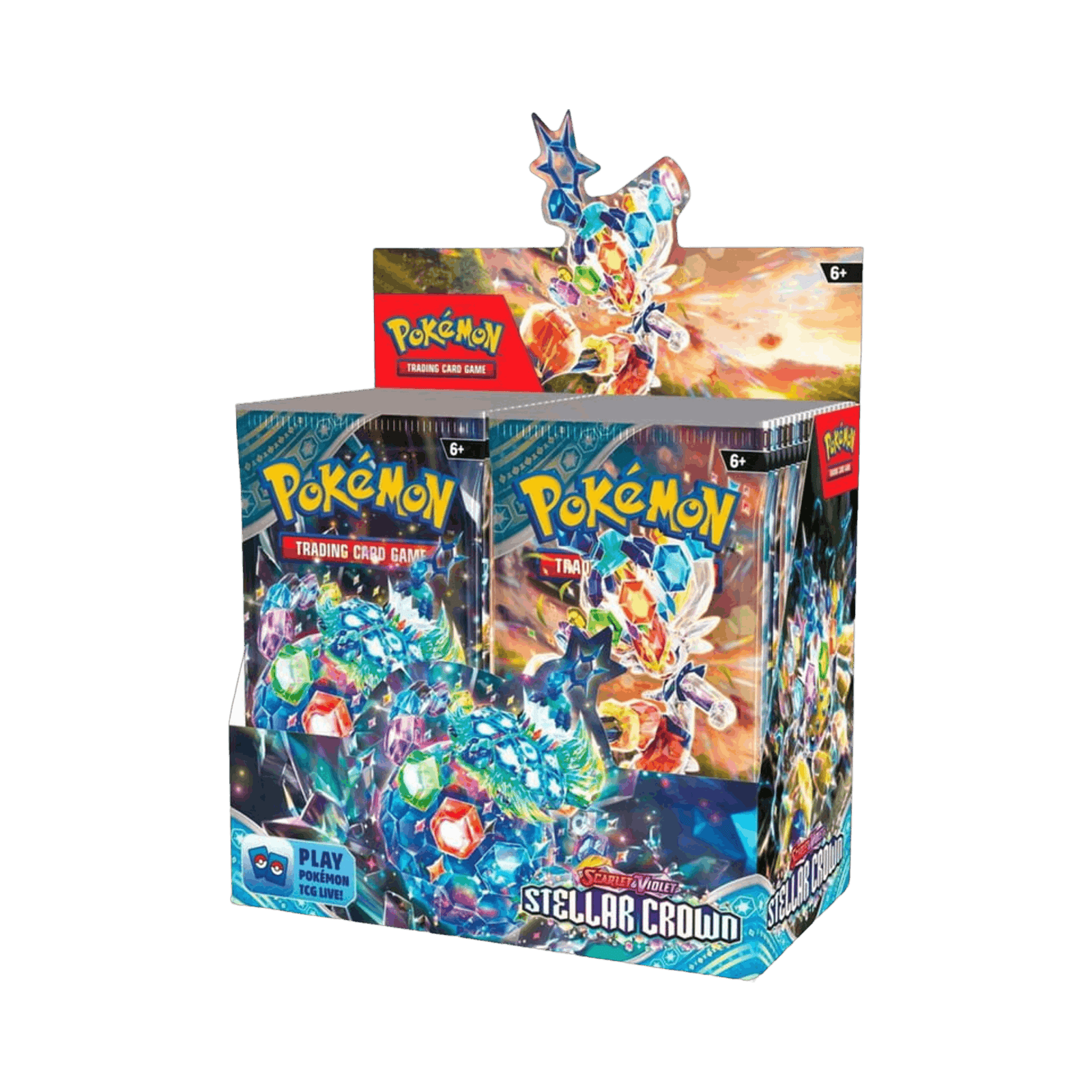

An English Pokémon booster box holds 36 packs of 10 cards. A standard Japanese booster box holds 30 packs of 5. That one difference shapes almost everything else about the two, from how a box feels to open to which one suits your shelf, your binder or your deck.
Quick answer: buy English if you want to play at official events or want more cards per box; buy Japanese if you care most about print quality, earlier sets and a smaller, chase-focused rip. Both are great sealed pieces when they are factory sealed and authentic.
Japanese vs English booster boxes at a glance
| English booster box | Japanese booster box | |
|---|---|---|
| Packs per box | 36 | 30 (standard expansion) |
| Cards per pack | 10 | 5 (standard expansion) |
| Cards per box | 360 | 150 |
| Set release | Later, often combining Japanese sets | First, usually weeks to months earlier |
| Official English-language tournaments | Legal | Not legal |
| Print quality | More variation in centering | Generally sharper and more consistent |
Sources: Folio, Packratt, Samurai Sword Tokyo and Miraj Trading pack and card guides.
How many packs are in a Japanese vs English booster box?
A standard English booster display is 36 packs, each with 10 cards, so 360 cards a box. A standard Japanese expansion box is 30 packs of 5 cards, so 150 cards. Japanese packs are smaller, which makes each one quicker to open and each hit feel like a bigger moment.
Japan also has special sets that break the standard format. Pokémon Card 151 boxes hold 20 packs of 7 cards, and High Class Pack boxes hold 10 packs of 10 cards, with the packs loaded towards holo and rare cards. Older Japanese favourites like Shiny Star V and Tag Team GX Tag All Stars come from this high-class style of release. Always check the pack count on the box rather than assuming, because the same "expansion pack" label appears on several box types.
Are Japanese Pokémon cards better quality?
Most collectors say yes, and the reasons are consistent. Japanese cards tend to have sharper print, more consistent centering and fewer edge issues out of the pack. On the big chase cards, Japanese illustration rares usually have deeper texture and a finer holo pattern, while English prints of the same art can show more of a rainbow streak.
That matters most if you plan to grade. A well-centred card straight from the pack gives you a better shot at a high grade, which is why many graders prefer to rip Japanese. Commons and uncommons look almost identical across both languages; the gap shows up at the rare end. Japanese cards also have a different card back from English cards, so the two never mix neatly in one binder page.
Why do Japanese sets come out first?
Pokémon sets launch in Japan first. The English version typically follows weeks to months later, and English sets often bundle cards from more than one Japanese set into one bigger release. Surging Sparks, for example, drew its cards from two Japanese sets, Super Electric Breaker and Paradise Dragona. That is why English sets usually have far more cards to chase than any single Japanese set.
There are exceptions. The 30th Celebration set launched worldwide in Japanese and English on the same day, 16 September 2026. For most main sets though, Japanese boxes are your way to open the newest cards first, and the English set lands later with a different mix.
Can you play Japanese cards in tournaments?
Not at official English-language events. Japanese Pokémon cards can't be used in English-language official tournaments, and English cards can't be used in Japanese official events. For kitchen-table games or a casual local league that doesn't enforce the official rules, it doesn't matter. If you or your kids want to build decks for sanctioned play, English is the one to buy.
Which should you buy: collecting, playing or keeping it sealed?
- For playing: English. More cards per box, every card readable, and legal at official English-language events. Stellar Crown and Twilight Masquerade are both great Scarlet & Violet era rips.
- For a binder or grading: Japanese. Better print consistency and the newest art first. Sun & Moon era boxes like Dream League and Night Unison are a favourite with art collectors.
- For opening with friends: English gives you more packs to share around; Japanese gives you a quicker, punchier rip.
- For keeping sealed: either works. The key is a box with its original factory wrap intact. Popular English boxes like Paradox Rift and Destined Rivals sit next to the Japanese classics on a lot of NZ shelves.
If you are new to Japanese boxes, our guide to Japanese Pokémon booster boxes in NZ covers the current Japanese sets in more detail.
Where to buy Japanese and English booster boxes in NZ
Every box we sell is factory sealed and 100% authentic, checked before it ships, and NZ shipping is free on every order. Afterpay is available at checkout. Browse the full range of Pokémon booster boxes, the Japanese Pokémon collection or everything in Pokémon, and see our where to buy Japanese Pokémon booster boxes in NZ page for more on buying safely. Whichever language you pick, check the shrink wrap: a box whose wrap has been cut and re-sealed is a box to walk away from.
FAQ
How many packs are in a Japanese Pokémon booster box?
A standard Japanese expansion box has 30 packs of 5 cards. Special sets differ: Pokémon Card 151 boxes have 20 packs of 7 cards and High Class Pack boxes have 10 packs of 10 cards.
How many packs are in an English Pokémon booster box?
A standard English booster display has 36 packs, each with 10 cards, for 360 cards in total.
Are Japanese Pokémon cards better quality than English?
Generally, yes. Japanese cards tend to have sharper print, more consistent centering and finer texture on rare cards, which is why many collectors and graders prefer them.
Can I use Japanese Pokémon cards in tournaments?
No, not at official English-language tournaments. Japanese cards are fine for casual play, but sanctioned English-language events need English cards.






Leave a comment (all fields required)